
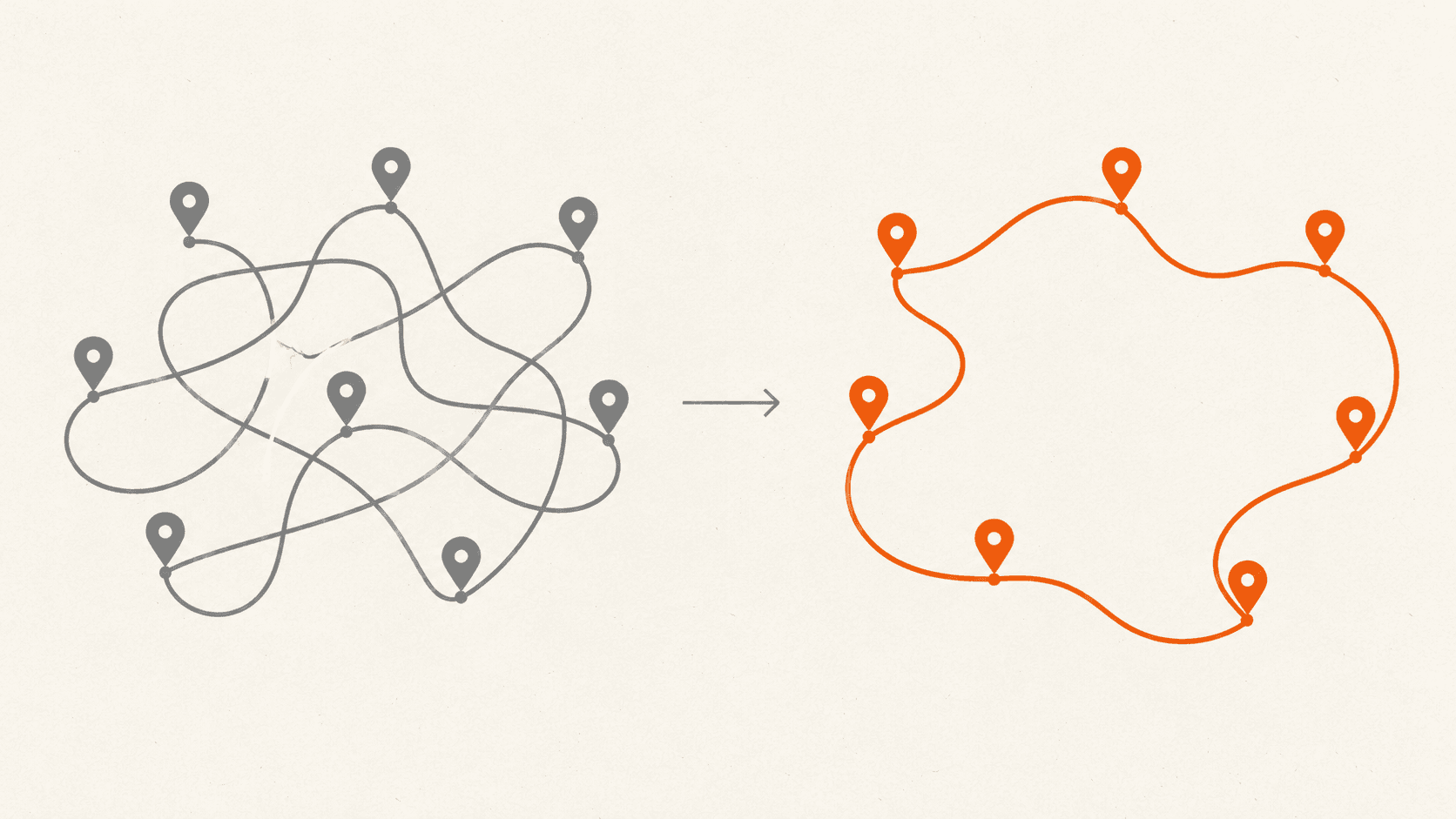
How multi-stop route optimisation works, and why it saves 15-18% of distance
Nine delivery stops can be ordered in 362,880 different ways. A plain-language look at the maths Voder uses to pick a short route, and what that does to your fare.
Manjunath Hiremath
Operations Lead · 12 March 2026 · 6 min read
Book a multi-stop delivery with nine drop points, and a quiet question decides a good part of what you pay: in what order should the driver visit them? Follow the order in which the stops were typed in, and the vehicle zigzags across town. Follow a well-chosen order, and the same nine parcels arrive with several kilometres less driving.
That ordering puzzle has a name. Mathematicians call it the travelling salesman problem, or TSP: given a list of stops, find the shortest route that visits each one exactly once. It sounds simple. It is famously not.
Why checking every option fails
With 3 stops there are only 6 possible orders, so you could check them all by hand. With 9 stops there are 362,880. With 15 stops there are over 1.3 trillion. No phone and no server checks every option for a busy route while a customer waits on the booking screen. So the trick is not to check everything. It is to get close to the best answer, quickly.
Voder starts with a construction step. From the pickup point, the optimiser repeatedly asks one question: of the stops not yet visited, which is nearest by road? Built this way, a full route is ready in milliseconds. This nearest-neighbour route is decent, but it usually leaves crossings in the path, places where the route doubles back over itself.
2-opt, the untangling step
This is where 2-opt earns its keep. Picture the route drawn on a map as a loop of string. Wherever the string crosses itself, you can pinch the two crossing segments, swap their ends, and the crossing disappears. The route gets strictly shorter each time. 2-opt does exactly this: it keeps testing pairs of route segments, reverses the section between them whenever that shortens the total, and repeats until no swap helps any more.
- Distances are measured along actual roads, not straight lines on a map.
- One-way streets are respected, so a stop 200 metres away can rightly count as a 1.4 km drive.
- Vehicle class matters: a lane that suits a 2-wheeler is not always open to a mini-truck.
So where does 15-18% come from? We measure the gap between the route as entered and the route after optimisation, across Davanagere multi-stop bookings with five or more stops. The saving is not uniform. If your stops were already entered in a sensible order, the optimiser may find only 3-4%. On scattered routes entered in whatever order the orders arrived, it regularly finds 20% or more. Across our bookings, the average settles between 15% and 18% of total distance.
What this means for your fare
Voder fares are distance-based and shown before you confirm. A shorter route is therefore not an internal efficiency we quietly keep; it is a smaller number on your screen. The driver finishes the round sooner too, which matters as much to the person behind the wheel as it does to your dispatch schedule.
If you send one vehicle to many points on most days, the effect compounds. Ten trips a week, each around 15% shorter, is roughly a day and a half of driving saved every month. See the multi-stop delivery page for how to set up a route, or run one booking side by side against your current arrangement and compare the bills.
Move smarter. Move with Voder.
One account for deliveries, rentals, and moving. No setup fee, no contracts.