
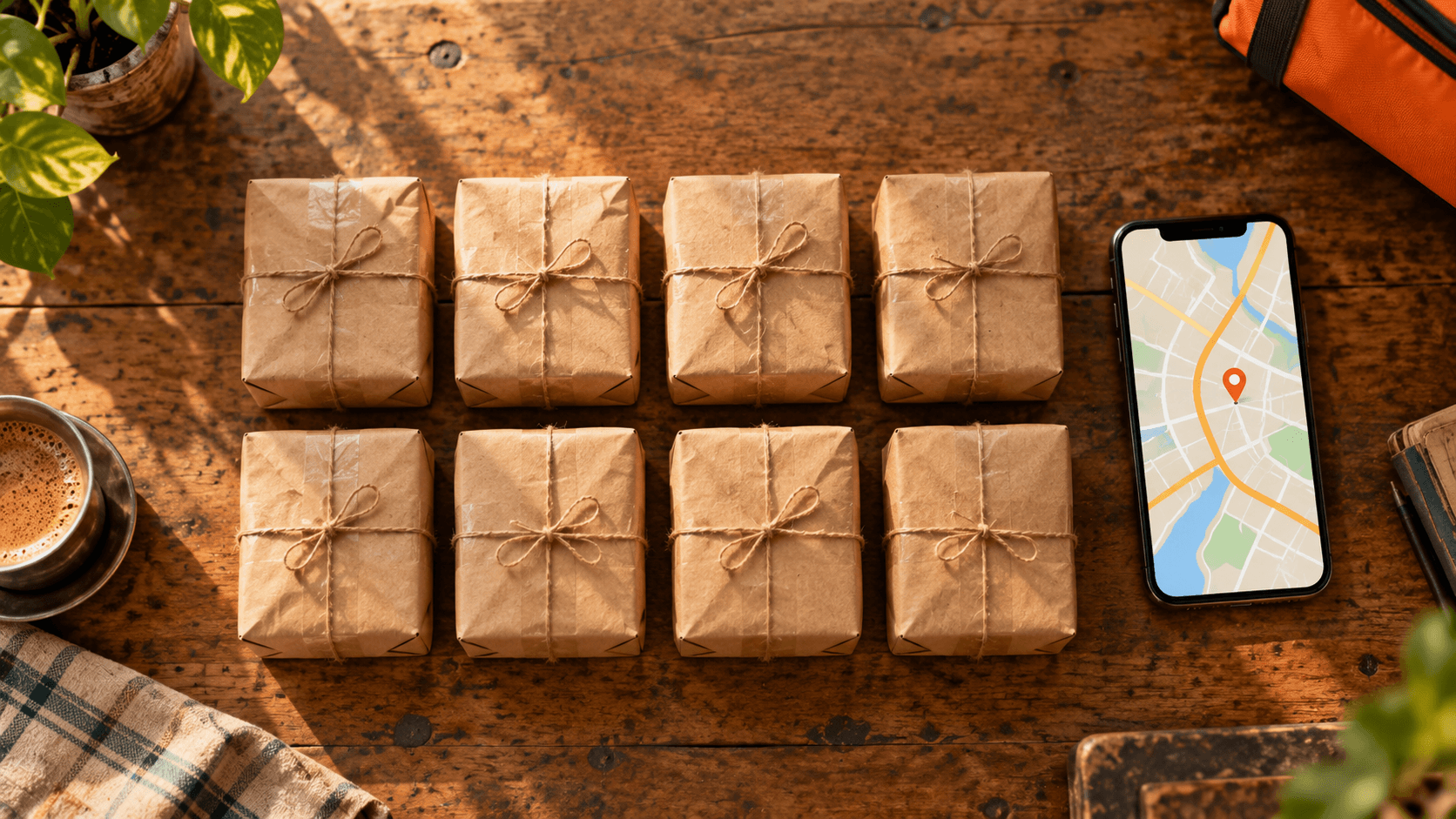
How D2C sellers and distributors cut delivery costs with batched routes and digital invoices
Fourteen bike trips, or one multi-stop run? The arithmetic of batching local orders, plus the digital invoices that turn transport from loose cash spend into a clean, auditable line.
Manjunath Hiremath
Operations Lead · 14 May 2026 · 6 min read
A saree seller in P J Extension ships around fourteen local orders a day. For a year, each order left the shop the moment it was packed, one bike trip at a time. The parcels reached quickly, and the delivery bill quietly became one of the shop's biggest costs. What changed the number was not a discount. It was a habit: holding the day's orders until 3 pm and sending them out as one route.
Two habits carry over from the courier era, and both cost money: dispatching every order the moment it is ready, and treating delivery as loose cash spend that nobody reconciles. This article is about replacing both.
Batching: one trip instead of fourteen
Batching means fixing a daily cutoff, collecting the day's local orders, and running them as a single multi-stop trip on a vehicle sized to the load: a 2-wheeler for documents and small boxes, a pickup van or mini-truck for cartons. Customers still receive same-day delivery; the parcels simply travel together instead of separately.
The route itself is ordered by the same optimiser we use everywhere on Voder: it treats your stops as a travelling salesman problem, builds a quick route, then untangles it with 2-opt refinement. Across Davanagere multi-stop bookings this saves 15-18% of distance compared with the entered order, and because fares are distance-based, the saving lands on your bill rather than in our margin.
Distributors: fixed beats, predictable costs
A pharma or FMCG distributor rarely has random stops; they have beats. Thirty kirana counters on a Tuesday round, twenty chemists on a Thursday. Save the beat as a repeat booking and the same optimised order runs every week, on a pickup van or mini-truck depending on the load. Delivery stops being a weekly negotiation with a hired tempo and becomes a line you can forecast for the quarter.
- A firm daily cutoff that your customers can see, for example, ordered by 2 pm, delivered today.
- Addresses captured with a landmark or a map pin, not just an area name.
- Parcels labelled by stop number once the route is set, so loading order matches drop order.
- One phone number that answers when the driver calls from a doorstep.
Invoices your accountant will not chase
Every completed Voder booking comes with a digital invoice in the app, ready to download or send to your accountant. Transport stops being a pile of cash slips and becomes a clean, auditable expense line. Keep the booking number and the invoice together for your records. And because the fare is shown and final before you confirm, there is no surprise arriving after the trip.
Photo proof of delivery earns its place here too. Each drop is closed with a photograph stored against the stop. When a retail counter says a carton never came, you settle it by opening the stop record, not by calling the driver at dinner time.
Start small. Batch two days a week for a month and track one number: delivery cost per order. If it does not fall, go back to single dispatch; the arithmetic usually decides for you. For volume terms and repeat-route pricing, talk to us through the partners page.
Move smarter. Move with Voder.
One account for deliveries, rentals, and moving. No setup fee, no contracts.