
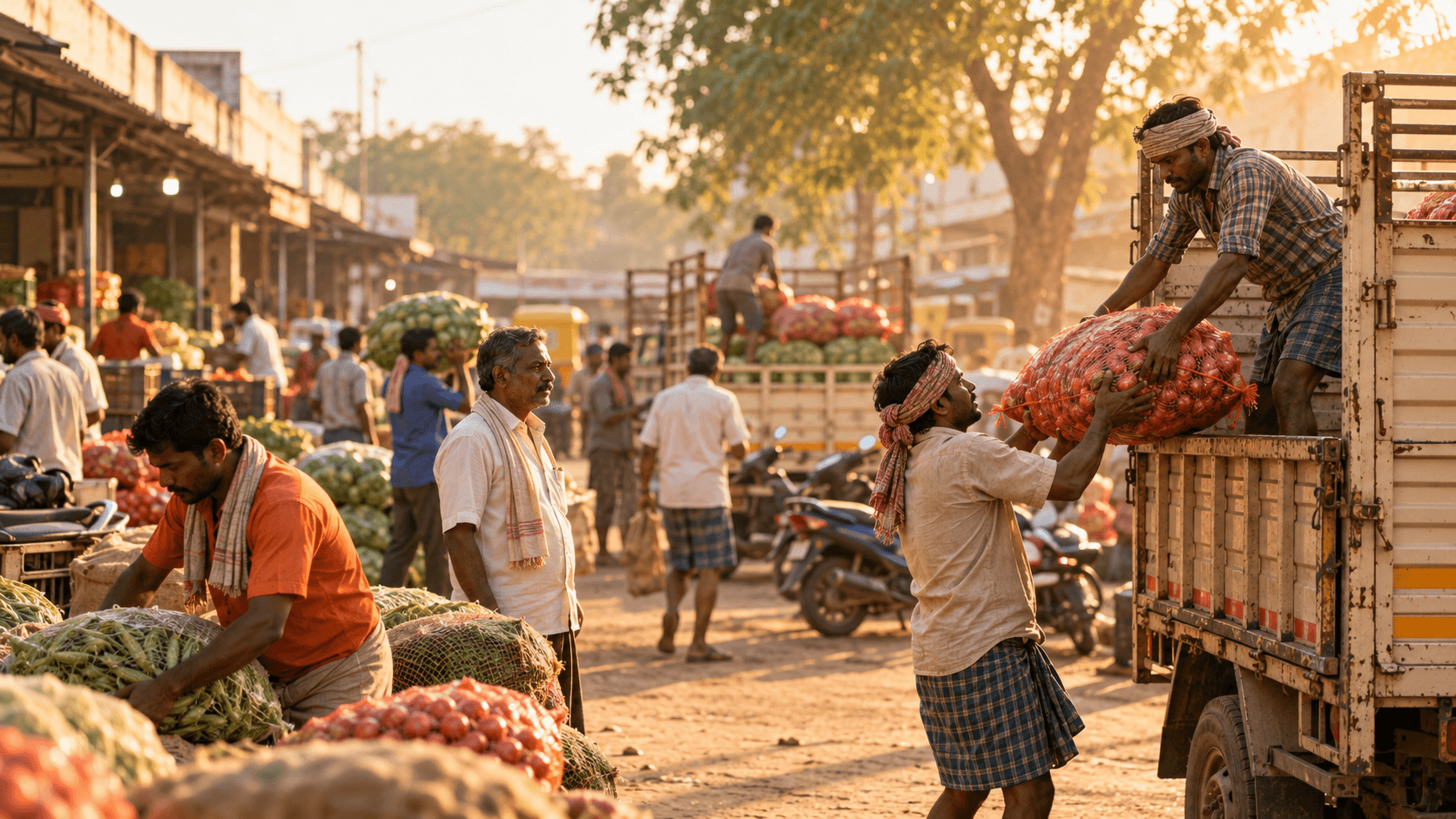
How goods actually move in Davanagere
Mandi mornings, arecanut loads from the Channagiri side, the KIADB estates and the NH-48 bypass: a working map of the city's freight, from people who drive it.
Basavaraj Kattimani
Driver Community Lead · 18 June 2026 · 6 min read
Davanagere sits almost exactly halfway between Bengaluru and Hubballi on NH-48, an old cotton-mill town that the trade never really left. The mills are gone, but the city still works like a market: maize in the mandi yard, arecanut in the trading lanes, rice mills and packaging units on the industrial edges, and benne dose at 8 am for anyone who has been loading a truck since dawn. If you want to run logistics here, you first learn the city's clock.
The mandi sets the morning
Davanagere is one of Karnataka's biggest maize markets, and the APMC yard is where the day starts. Tractors and mini-trucks queue from early morning; auctions and weighing push loading into a rush that peaks between 8 and 11. A vehicle that reaches the yard at 9 waits. A vehicle that reaches at 7 loads and leaves. Half the price of reliability here is simply arriving at the right hour.
The old trading core around Mandipet is a different machine altogether: narrow lanes, godowns above shops, and hand carts doing work no vehicle can. By 10:30 the lanes are jammed. The practical pattern is a relay: a mini-truck stages at the edge of the market streets, and the last 300 metres belong to 2-wheelers, carts and shoulders. Booking a large vehicle straight into Mandipet at noon does not make the delivery faster; it makes it later.
Arecanut moves carefully
To the east, Channagiri taluk is one of the state's densest arecanut belts, and much of that crop is traded through Davanagere. Arecanut is high value for its weight; a single pickup load can be worth several lakhs. So the trade runs on named drivers, small insured loads and paper that matches the bags. This is where photo proof of delivery and insurance tiers stop being app features and become the reason a trader hands over the load at all.
“For adike I do not send with a stranger. One pickup load is worth lakhs. I want the driver's name before loading, and the photos when it is unloaded.”
KIADB estates and the industrial edge
On the city's edges, the KIADB industrial areas hold rice mills, food processing, packaging and engineering job-work units. Their flows are steady rather than seasonal: raw material in off NH-48, finished goods out to Bengaluru, Hubballi and beyond. Job-work batches move between units on pickup vans on fixed days, and a missed afternoon slot can idle a machine the next morning. Here, reliability matters more than price, and everyone involved knows it.
NH-48 is the artery and the bypass is the valve. Long-haul trucks stay on the bypass, and the town core has practical limits on heavy vehicles during business hours. So freight changes vehicles at the edge: a 12-ton load arrives on the bypass, and mini-trucks and pickups ferry it inward. Half of local logistics knowledge is knowing exactly where that handover happens smoothly, and at what hour.
- Mandi loading peaks between 8 and 11 am; arrive before 7 or after noon.
- Old-town lanes around Mandipet are workable before 10 am and after 8 pm.
- In the monsoon months, June to September, keep tarpaulins on and add 20 minutes to loading.
- Evening school and college traffic slows the ring road between 4:30 and 6:30.
None of this appears on a national routing engine's map. It lives in drivers' heads. Our dispatch team sits in Davanagere, most of our drivers grew up on these roads, and the app's routes keep getting corrected by what they report back.
That, in practice, is what live in Davanagere means. If you trade through the mandi, run a unit in a KIADB estate, or simply need a fridge carried across town, the Davanagere city page shows what is bookable today, in Kannada and English.
Move smarter. Move with Voder.
One account for deliveries, rentals, and moving. No setup fee, no contracts.